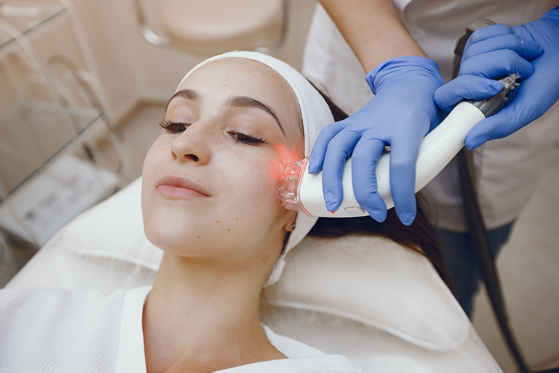
Tattoo removal lasers and the ones for skin resurfacing are designed to work differently. One delivers extremely short, high-power pulses, and the other delivers controlled heat in tiny columns to trigger collagen renewal. Different targets absorb different wavelengths, and one setting is not designed to do the job of two.
Key Takeaways
- Tattoo removal and skin resurfacing both use laser technology for different results.
- The treatments use completely different laser settings, light wavelengths, and techniques.
- You should never proceed without following all checks.
- Remember to choose a qualified practitioner who is experienced and follows industry standards.
Lasers are more than a simple technology. It is a powerful tool used by experts in the beauty industry for a series of reasons. Lasers are described as a single technology, but they behave more like a toolkit.
However, each device using lasers is built around a specific wavelength, pulse duration, and delivery method. This means there isn’t one setting for achieving desired results, and the settings need to be changed depending on the goal.
That is why a laser that fades a tattoo cannot simply be turned towards wrinkles. To understand this a little better, here we will be focusing on two laser treatments, laser skin surfacing and laser tattoo removal. This will help you understand the science behind each treatment and how they differ.
Why Wavelength Matters
The light used in laser treatments only affects what absorbs it. Our skin contains different targets, which is why each treatment needs a wavelength matched to its goal. This is what you need to know:
- Ink pigment: The colour of the tattoo particles plays a big role. The particles absorb specific wavelengths depending on their colour.
- Water in tissue: Resurfacing lasers are absorbed by water in the skin. This, in turn, produces controlled heat.
- Melanin and haemoglobin: Other pigments compete for light, which is why skin tone affects settings.
See also: Deck Repair: Essential Steps to Restore Safety and Extend Lifespan
How Laser Tattoo Removal Works
You must understand the process before you proceed to book your appointment for laser tattoo removal in London. And here’s what you need to understand:
Experts at London clinics rely on short-pulse, high-peak-power systems for laser tattoo removal. These systems deliver energy in nanoseconds or picoseconds, which are billionths or trillionths of a second.
The pulse is so brief that the ink absorbs the energy faster than heat can spread. As a result of this, the pigment fractures into smaller fragments, which the body gradually clears over some time.
Most important of all, wavelength then determines which colours respond:
- 1064 nm: This is designed to target dark inks such as black and deep blue.
- 532 nm: This is best suited for red, orange, and some brown pigments.
- Red-range wavelengths: These wavelengths are widely used for green and light blue inks.
Pastel and white inks are generally the most stubborn to get rid of. This is why complete removal becomes tough.
How Laser Skin Resurfacing Works
This is a highly popular treatment, designed to improve skin’s texture and achieve a youthful appearance. The process focuses on collagen renewal, which generally slows down with age.
The experts in laser skin resurfacing in London rely on fractional non-ablative beams. During this process, the laser doesn’t treat the whole surface; rather, it creates thousands of microscopic heated zones.
After that, healthy tissue surrounds each zone, which speeds recovery. The skin responds by remodelling collagen, which gradually improves texture, fine lines, and mild scarring.
Here are a few terms that you need to understand before you start are worth understanding:
- Fractional: During this, only a fraction of the skin is treated at once. This leaves untreated bridges between zones.
- Non-ablative: This is a laser skin resurfacing process during which the surface is heated and not vaporised. This is why the downtime is usually lower.
- Ablative: During this treatment, the surface tissue is vaporised. This is designed to deliver stronger results, but recovery takes a long time.
Why Multi-Laser Platforms Suit Custom Planning
There are many places that offer laser tattoo removal and laser skin resurfacing in London. However, multi-laser platforms are increasingly used so that treatment can be matched to the individual.
Here is what you need to know:
- Tailored wavelengths: Different inks and skin concerns are designed to be addressed with different modules.
- Skin tone adjustment: Experts focus on settings that can be adapted for lighter and deeper skin tones.
- Combined plans: Some experts combine laser skin resurfacing and laser tattoo removal in London depending on the client’s requirements. A tattoo is faded first, and then the expert plans for improving the skin’s texture.
- Staged timing: Treatment plans are designed keeping healing in mind. They are spaced perfectly so skin has time to heal between sessions.
What to Check Before Booking Any Laser Treatment
Laser treatments are great. They help in achieving desired results without any extensive procedures.
However, safety is a major part of these treatments. Experts suggest that laser skin resurfacing and laser tattoo removal are usually safe. However, it needs to be carried out by an experienced and suitably qualified practitioner.
Here are the checks that you need to make:
- Ask whether the practitioner is on a register showing set standards in training, skill, and insurance.
- Make sure the laser matches the ink colour or skin concern being treated.
- Patch tests are great for safety; performing this test on a small area shows how your skin responds before full treatment.
- You must expect gradual change over several sessions.
In Summation
Laser tattoo removal and laser skin resurfacing both use the power of lasers. But they differ in their purpose, technique, and results.
One is designed to break apart ink with ultra-short pulses. On the other hand, the other stimulates collagen with controlled fractional heat. So, you need to understand this before choosing any service or both.
Confident to Get Laser Treatment in London?
Laser is great for achieving desired skin results. But remember to choose a clinic in London, one that is reliable and follows all standards.