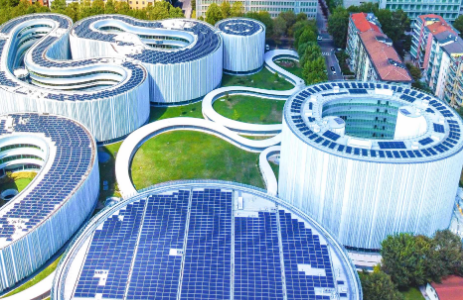
You can turn parts of your building—roof, façade, or windows—into power-producing surfaces without adding bulky racks or separate equipment. Building-integrated solar panels replace or become part of the building envelope, generating electricity while serving as functional materials like roofing or glazing, so you save space and maintain a cohesive design.
This post will show how building integrated solar panels work, what design and installation choices matter, and which benefits matter most for your project. If you want practical guidance on performance, aesthetics, costs, and real-world tradeoffs, keep going to learn the core concepts and what to consider when integrating solar directly into your building.
Core Concepts of Building Integrated Solar Panels
You’ll learn what BIPV actually is, the main product types and how they function, and the practical differences between integrated systems and conventional rooftop arrays.
Definition and Overview
Building-integrated photovoltaics (BIPV) replace or serve as building materials while generating electricity. Instead of mounting panels on an existing roof, BIPV elements form part of the envelope—roofing, façades, skylights, curtain walls, or windows—so they perform weatherproofing, insulation, daylighting, or shading as well as power generation.
BIPV systems connect to the building electrical system and can be grid-tied or paired with storage. You should evaluate site irradiance, local codes, structural loads, and thermal performance early, because BIPV decisions affect both architecture and MEP design. Durability, fire rating, and visual integration are common permitting focal points.
Types of Building Integrated Solar Panels
Common BIPV types include:
- Roof-integrated modules: Shingles or tiles that replace roofing material. They sit flush and provide waterproofing while producing electricity.
- Façade panels: Flat or ventilated cladding with embedded cells for vertical generation and shading.
- Transparent/semiconducting glazing: Solar glass or thin-film coatings used in windows, skylights, and atria that balance light transmission with energy capture.
- Custom curtain-wall modules: Structural glass or composite panels designed into curtain-wall systems for large commercial façades.
Performance varies by technology: crystalline cells offer higher conversion efficiency; thin-film and organic PV allow translucency and flexibility. Choose based on aesthetics, U-value targets, weight limits, and expected kWh/m² for your orientation.
Comparison to Traditional Solar Panels
Functionally, BIPV replaces building materials; conventional PV mounts above the existing roof. That difference leads to trade-offs: BIPV improves aesthetics and can reduce material and labor by consolidating functions, but it often costs more per watt and can have lower peak efficiency due to suboptimal tilt or partial shading.
Key comparative points:
- Cost per watt: Typically higher for BIPV because of customization and integrated components.
- Energy yield: Conventional arrays usually produce more kWh per m² when optimally tilted and spaced.
- Design impact: BIPV affects architectural decisions, thermal performance, and fire/egress details. Conventional PV imposes fewer changes to building envelope design.
- Maintenance & replacement: BIPV elements may require coordinated building-material replacements; standard panels are easier to swap.
You should weigh lifecycle costs, aesthetic requirements, and performance goals when choosing between integrated and mounted systems.
Design, Installation, and Benefits
This section explains how integrated panels fit into building design, how they perform, common installation obstacles and fixes, and the environmental and economic outcomes you can expect.
Architectural Integration and Aesthetics
You control visual outcomes by choosing panel type, placement, and finish. Options include flush-mounted roof tiles, façade modules that match cladding lines, and semi-transparent glazing for windows or skylights. Match module color, texture, and frame profiles to existing materials to preserve architectural intent.
Work with your architect and installer early so structural loads, water drainage, and window sightlines are coordinated. Specify module dimensions and mounting systems to align with mullions, parapets, and roof penetrations. Consider sightline mockups or sample panels on-site before final ordering.
Energy Efficiency and Performance
Select modules rated for your climate and orientation: high-efficiency monocrystalline cells for limited roof area, and thin-film or BIPV glass where weight or translucency matters. Check manufacturer STC/PVUSA ratings and temperature coefficients to predict real-world output in heat or partial shade.
Design the array to minimize shading from parapets, nearby structures, and ventilation stacks. Incorporate string sizing, microinverters, or optimizers to limit mismatch losses across varied orientations and obstructions. Include accessible monitoring so you can track generation and spot underperformance quickly.
Installation Challenges and Solutions
You’ll face sealing, structural, and electrical integration challenges unique to BIPV. Roof- or façade-integrated modules often replace weatherproofing layers, so flashing details and membrane continuity must be engineered rather than improvised. Use manufacturer-prescribed flashing kits and test water tightness during commissioning.
Structural capacity can require reinforcing rafters or specifying lighter module substrates. Coordinate early with structural engineers to size supports and specify wind/uplift anchoring. For electrical work, route conduits discreetly into service locations and follow local code for rapid shutdown and labeling to pass inspection. Plan maintenance access and removal procedures for future repairs.
Environmental and Economic Advantages
BIPV reduces embodied material use by combining cladding/roofing with electrical generation. You cut duplication of materials and, often, reduce lifecycle carbon compared with separate PV plus traditional envelope materials. Choose long-life modules and recyclable mounting systems to maximize environmental benefits.
Economically, you may save on material and labor compared with separate systems, and increase usable property value through integrated design. Evaluate incentives, tariffs, and net metering that apply in your jurisdiction, and run a lifecycle cost analysis including maintenance, expected degradation (typically 0.5–1%/year), and replacement scenarios.