From AI flow simulations to low-temperature curing, modern innovations streamline development, protect delicate electronics, and ensure strict regulatory compliance across production.
Key Takeaways:
- Accelerates Time-to-Market: Liquid Silicone Rubber (LSR) injection molding drives strategic speed and builds regulatory confidence alongside superior part quality.
- Adapts to Complexity: It scales seamlessly to meet the demands of smaller, increasingly intricate medical devices.
- Secures the Supply Chain: LSR delivers a resilient, compliant, and cost-effective process from initial prototyping to high-volume production.
Medical device engineering demands absolute precision, uncompromised biocompatibility, and batch-to-batch repeatability. Liquid Silicone Rubber (LSR) injection molding has quickly become the gold standard for high-performance components.
Discover how recent technological breakthroughs are overcoming traditional production bottlenecks, reducing development costs, and elevating quality standards across modern healthcare manufacturing.
9 LSR Injection Molding Innovations Transforming Medical Devices
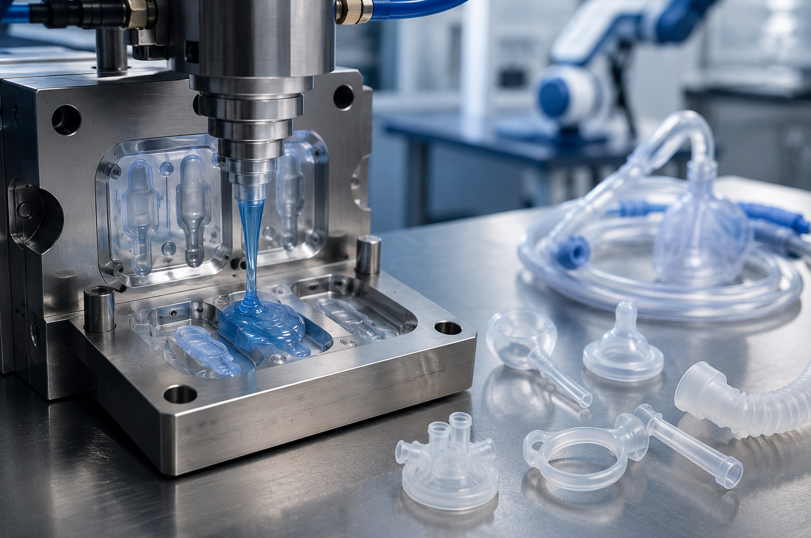
Medical device makers need parts that are precise, biocompatible, and repeatable at scale. That is why injection molding of liquid silicone rubber (LSR) has become the go-to process for medical silicone molding in 2026.
Here are the 9 innovations that are reshaping the industry right now:
#1 AI-Driven Mold Flow Simulation
Mold design (or tool design) used to depend on trial-and-error, but not anymore. AI-assisted flow simulation predicts fill patterns, weld lines, and shrinkage before a tool is ever cut.
With AI assistance, businesses observe-
- Fewer prototype iterations
- Faster time-to-production
- Lower tooling costs
Engineers can validate part performance under real-world stress before cutting steel, with a combination of AI and FEA (finite element analysis) during the design phase.
#2 Real-Time Process Monitoring
The sensors embedded in LSR injection presses now track-
- Cavity pressure
- Cure temperature
- Shot-to-shot consistency
This data feeds back into the press controller instantly. As a result, parts that meet tight tolerances, shot after shot, are developed, with far less scrap.
#3 Micro-Molding for Miniaturized Devices
Medical devices are shrinking with each passing year. Drug-delivery components, catheters, and wearable sensors need micro-scale silicone parts.
Micro-LSR molding now creates-
- Wall thicknesses under 0.1 mm
- Tolerances within microns
- Complex geometries in a single shot
This innovation is a direct response to the industry’s advancement towards minimally invasive and wearable medical technology.
#4 Low-Temperature Cure Materials for Heat-Sensitive Overmolding
Standard LSR requires 140°C to 200°C. In comparison, new low-temperature cure Liquid Silicone Rubber (LSR) formulations typically cure between 60°C and 90°C.
This advancement protects delicate sensors, films, and batteries from thermal degradation while maintaining biocompatibility. It enables overmolding directly onto fully assembled, heat-sensitive medical electronics.
This advancement is particularly critical for:
- Wearable biosensors
- Implantable electronics
- Overmolded connectors and cables
#5 Expanded Durometer & Biocompatible Material Ranges
Medical applications require varying degrees of hardness and flexibility. LSR libraries that span 5A to 85A durometer provide designers flexibility across tactile performance, structural damping, and sealing mechanics.
This flexibility is effective for-
- Soft-touch wearable seals
- Rigid structural housings
- Everything in between
Pairing this with medical-grade, USP Class VI silicone sourced from trusted US and European suppliers ensures biocompatibility for skin contact and implantable use.
#6 Multi-Cavity, High-Precision Tooling
High-volume medical production demands consistency across thousands of parts. Advanced mold design along with CAM-driven tooling now enable multi-cavity molds where-
- Every cavity produces an identical part
- Cycle times drop significantly
- Cost-per-part scales down as volume scales up
The goal is to make the first part and the millionth part become indistinguishable.
See also: Family Law Toronto Ontario: Practical Guidance on Separation, Custody, and Support
#7 Cleanroom-Integrated Automation
Medical silicone molding increasingly happens inside cleanroom-adjacent environments with automated part handling.
Robotic deflashing, automated inspection, and enclosed material handling reduce-
- Human contact contamination risk
- Particulate exposure
- Variability between operators
This matters most for implantable and skin-contact devices where contamination control is non-negotiable.
#8 Six Sigma & Lean Manufacturing Integration
Precision molding is only half the story. Process discipline is the other half.
Lean manufacturing principles combined with Six Sigma quality control now govern-
- Incoming material inspection
- In-process quality checks
- Final part validation
This systemized approach drives repeatability, critical for FDA-facing medical supply chains.
#9 Rapid Prototyping-to-Production Pipelines
Speed matters. Medical device startups cannot wait over 6 weeks for silicone prototypes.
The newest innovation, that is medical silicone molding, is not just a material or a machine. It is the pipeline itself-
- Rapid silicone prototyping
- Short-run validation molding
- Seamless transition to high-volume LSR injection production
One connected process. No re-engineering between stages.
Importance of These Innovations for Medical Device Makers
Injection molding of liquid silicone rubber sits at the intersection of precision engineering and regulatory rigor. The discussed innovations reduce risk, improve part consistency, and cut development time. All without compromising biocompatibility.
To Summarize
LSR injection molding directly solves high scrap rates and thermal sensitivity challenges. By integrating AI flow simulation, low-temperature curing, and cleanroom automation, medical device makers accelerate time-to-market, protect delicate electronics, and achieve micron-level precision at scale.
Ready To Optimize Your Medical Silicone Components For Scalable Manufacturing?
Evaluate your current part design against modern LSR capabilities to identify cost-saving opportunities and prevent mold defects early. Consult with a qualified silicone molding specialist today to review your FEA simulations, material specifications, and cleanroom production requirements.